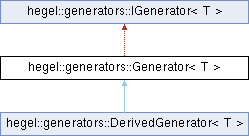
The base class of all generators. More...
#include <core.h>
Public Types | |
| using | value_type = T |
| The type of value this generator produces. | |
Public Member Functions | |
| template<typename F> | |
| Generator< std::invoke_result_t< F, T > > | map (F &&f) const |
| */ | |
| template<typename F> | |
| std::invoke_result_t< F, T > | flat_map (F &&f) const |
| Chain generators for dependent generation. | |
| Generator< T > | filter (std::function< bool(const T &)> pred) const |
| Filter generated values by a predicate. | |
Detailed Description
class hegel::generators::Generator< T >
The base class of all generators.
- Template Parameters
-
T The type to generate values for
Member Function Documentation
◆ filter()
|
inline |
Filter generated values by a predicate.
Creates a Generator that only produces values satisfying the predicate. The new Generator has the same type as this Generator.
So for example, if you want sorted lists of length N, you should generate sorted lists of length N, not generate random lists and filter by a predicate of 'length == N && is_sorted'. (Although the latter is logically correct, it would be a performance nightmare, so Hegel doesn't let you do it that way.)
For example, if you want sorted lists of length N, you should generate lists of length N and sort them, not generate random lists and filter by a predicate of 'length == N && is_sorted'.
- Parameters
-
pred Predicate that values must satisfy
- Returns
- Generator<T> producing only values satisfying pred
◆ flat_map()
|
inline |
Chain generators for dependent generation.
Given a Generator<T> and a function T -> Generator<S>, creates a Generator<S>. Useful when generation parameters depend on previously generated values.
- Template Parameters
-
F Function type (T -> Generator<S>)
- Parameters
-
f Function that takes a T and returns a Generator<S>
- Returns
- Generator<S> producing values from the chained generator
◆ map()
|
inline |
*/
Transform generated values with a function.
Given a Generator<T> and a function T -> S, creates a Generator<S>.
This works by generating values from the Generator<T> and applying a transformation to each value.
Here's an example of how you'd use this:
- Template Parameters
-
F Function type (T -> S)
- Parameters
-
f Transformation function with signature S f(T)
- Returns
- Generator<S> producing transformed values
- See also
- flat_map()
The documentation for this class was generated from the following file:
- include/hegel/core.h